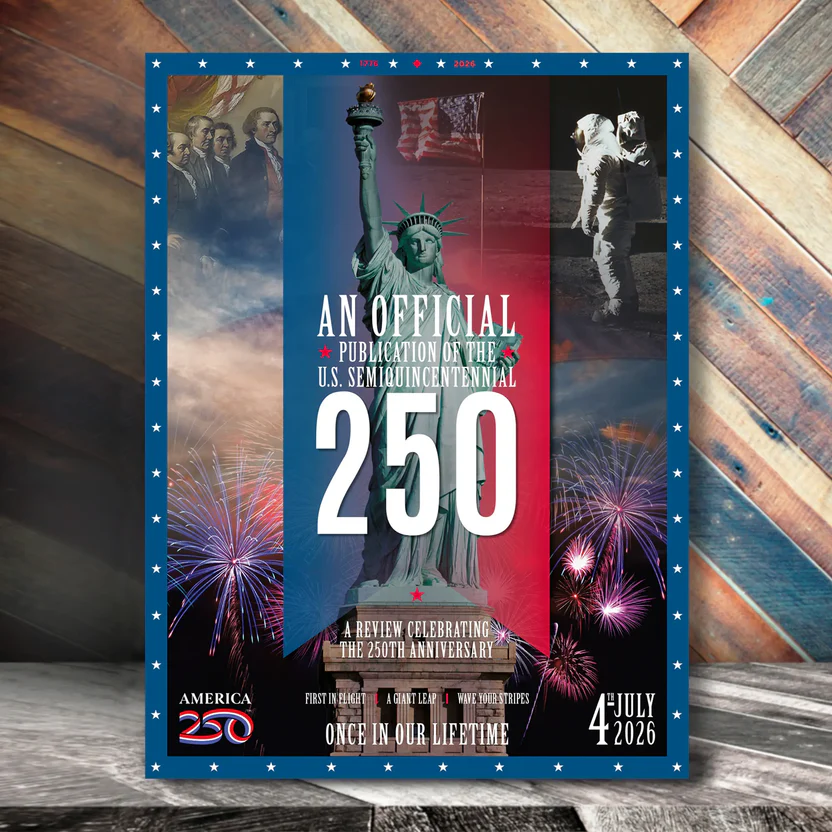
On July 4, 1776, the Second Continental Congress adopted the Declaration of Independence, and thirteen colonies announced themselves to the world as a new and free nation. Two hundred and fifty years later, that same date arrives carrying the weight of a quarter-millennium of history — and an invitation to celebrate it together.
The Fourth of July has always been more than a date on the calendar. It is the moment Americans set aside to remember where the country began, to measure how far it has traveled, and to imagine where it might go next. In 2026, that reflection reaches a milestone no living American has witnessed: the Semiquincentennial, the nation's 250th birthday.
Why This Fourth Is Different
Every Independence Day matters, but a 250th comes around exactly once. The men and women who signed the Declaration could not have known whether their experiment would last a decade, let alone two and a half centuries. That it has endured — through revolution, civil war, expansion, hardship, and renewal — is the story this Fourth invites every American to celebrate.
"We hold these truths to be self-evident, that all men are created equal." — The Declaration of Independence, July 4, 1776
How America Marks the Day
From small-town parades and backyard cookouts to fireworks bursting over harbors and capitals, the Fourth is the most distinctly American of holidays. In 2026, communities across all fifty states are planning expanded celebrations — bell ringings, readings of the Declaration, naturalization ceremonies welcoming new citizens, and tributes to the people and ideas that shaped the republic.
A Celebration Once In Our Lifetime
The America250 Journal is marking the occasion all year, with stories of the founders, the states, the innovators, and the everyday Americans who built the country. But the heart of it all is this single day — the Fourth of July — when a nation pauses to celebrate the simple, radical idea that a free people can govern themselves.
Happy 250th, America. Here's to the next quarter-millennium.
From Pastime to Powerhouse: 250 Years of American Sport, 1776–2026
When the Founders signed the Declaration of Independence in 1776, there was no NFL Sunday, no Opening Day, no checkered flag at Indianapolis. There were horse races on dusty village commons, informal games of "base ball" and cricket, footraces, and rough-and-tumble contests held after the harvest. Yet the seeds of a sporting nation were already in the soil. Over the next 250 years, as the country expanded from thirteen colonies to a continental power, Americans built the most influential sports culture on Earth — a patchwork of leagues and circuits that now anchor the national calendar.
As the United States marks its Semiquincentennial in 2026, it is worth tracing how the games we love actually began. Here is the story of seven institutions — MLB, the NFL, the NHL, the NBA, NASCAR, IndyCar, and MLS — and the years that gave them life.
The Long Beginning (1776–1850)
For the first several decades of the republic, organized sport barely existed in any modern sense. The earliest spectator sport in America was horse racing, which drew crowds in Virginia and the Carolinas before the Revolution and remained popular afterward. Boxing, rowing, and pedestrianism (competitive walking) attracted gamblers and onlookers in the early 1800s.
Baseball's roots reach back to this era. In 1845, a New York bookkeeper named Alexander Cartwright helped codify the "Knickerbocker Rules," giving the sandlot game a recognizable shape: bases, foul lines, three outs. It was an amateur, gentlemanly affair — but it was spreading fast, carried along railroads and, soon, by Civil War soldiers who played it in camp. By the time the guns fell silent in 1865, baseball had a real claim to being the national game.
It is worth pausing on why this mattered. A young, rapidly growing nation lacked many of the shared rituals that older countries took for granted. Sport began to fill that gap — giving immigrants, factory workers, and farm towns a common language and a reason to gather. The leagues that follow in this story were not just business ventures; they were nation-building institutions, knitting strangers into fans and cities into rivals. Each founding date below marks a moment when an informal pastime hardened into a permanent fixture of American life.
Major League Baseball — 1876
Professional baseball arrived in 1869 with the Cincinnati Red Stockings, the first openly all-salaried team. But the institution we know today traces its founding to 1876, when the National League was established to bring order, stable schedules, and respectability to a sport plagued by gambling and chaos. A rival, the American League, formed in 1901, and the two made peace in 1903 — the year of the first modern World Series.
That two-league structure, knit together under the Major League Baseball banner, makes MLB the oldest of America's major professional leagues. For generations it stood alone as "the national pastime," its rhythms — spring training, the long summer, the autumn classic — woven into American life. Babe Ruth, Jackie Robinson's barrier-breaking debut in 1947, and a century and a half of mythology all flow from that 1876 founding.

The Indianapolis 500 and IndyCar — 1911
American motorsport found its cathedral in the Midwest. The Indianapolis Motor Speedway opened in 1909, and in 1911 it hosted the first Indianapolis 500 — a 500-mile test of machine and nerve that instantly became one of the most prestigious races in the world. Ray Harroun won that inaugural running, reportedly using one of the first rear-view mirrors so he could race without a riding mechanic.
The governing structure of American open-wheel racing evolved over the next century. The American Automobile Association (AAA) sanctioned the early decades; after the 1955 Le Mans disaster, the United States Auto Club (USAC) took over in 1956. A breakaway series called CART formed in 1979, and in 1996 the Indy Racing League split off, beginning a damaging civil war within the sport. The two sides finally reunited in 2008 under the banner of the modern IndyCar Series, consolidating more than a century of speed into a single championship — with the Indy 500 still its crown jewel.
The National Hockey League — 1917
Hockey is shared heritage between the United States and Canada, and the NHL reflects that. Founded in 1917 in Montreal — the successor to the earlier National Hockey Association — the league began as a small, cold-weather circuit of Canadian clubs. American expansion came quickly: the Boston Bruins joined in 1924 as the first U.S.-based team, and within a few years franchises in New York, Chicago, and Detroit had taken root.
For decades the league was defined by the "Original Six," the iconic franchises that competed from 1942 to 1967. The NHL's dramatic American growth — into Sun Belt cities once thought hopeless for ice hockey — came later, but the league's 1917 founding makes it a centenarian, and the Stanley Cup it awards (first presented in 1893) is the oldest trophy in North American professional sports.
The National Football League — 1920
American football grew out of the colleges in the late 19th century, shaped by Walter Camp's rule changes into a distinctly American sport. The professional game, however, was scattered and disreputable until 1920, when a group of team owners gathered in a Hupmobile car dealership in Canton, Ohio, to form the American Professional Football Association. Legendary athlete Jim Thorpe was its first president. Two years later, in 1922, the league renamed itself the National Football League.
The NFL's rise to dominance was anything but guaranteed. For much of the 20th century it trailed baseball and college football in popularity. The turning point came with television: the 1958 NFL Championship — "The Greatest Game Ever Played" — and the 1967 birth of the Super Bowl transformed pro football into a cultural juggernaut. Today the NFL is the most popular and most lucrative sports league in the country, a Sunday ritual for tens of millions. It all began in that Canton showroom in 1920.
The National Basketball Association — 1946
Basketball is the one major American sport with a precise birth: it was invented in 1891 by Dr. James Naismith, a physical educator in Springfield, Massachusetts, who nailed a peach basket to a gymnasium balcony to keep students active in winter. The game spread through YMCAs and schools with astonishing speed.
The professional league came later. On June 6, 1946, arena owners founded the Basketball Association of America to fill their buildings on nights without hockey. In 1949 the BAA merged with the rival National Basketball League to form the National Basketball Association. The early NBA was a gritty, low-scoring affair until the 24-second shot clock (1954) opened up the game. The Bill Russell–led Celtics dynasty, the Magic-versus-Bird rivalry of the 1980s, and the global icon Michael Jordan turned the NBA into America's most international league — but its founding year remains 1946.
NASCAR — 1948
While open-wheel cars circled Indianapolis, a different kind of racing was roaring to life in the American South. Its roots lie partly in Prohibition, when bootleggers souped up their cars to outrun federal agents and then raced one another for bragging rights. Bill France Sr., a mechanic and promoter in Daytona Beach, Florida, saw a business in it. On February 21, 1948, he incorporated the National Association for Stock Car Auto Racing — NASCAR — to standardize the rules and crown a national champion.
The first "Strictly Stock" season (the ancestor of today's Cup Series) ran in 1949. NASCAR grew from a regional curiosity into one of the most-watched sports in the country by the 1990s and 2000s, with the Daytona 500 as its showcase. Family-run from the start, it remains closely tied to the France family and to the Southern roots that gave it character.
Major League Soccer — 1993
Soccer is both the world's game and, for much of American history, an afterthought. That changed when the United States hosted the 1994 FIFA World Cup — on the condition that the country establish a top-flight professional league. Major League Soccer was founded in 1993 and kicked off its first season in 1996 with ten teams.
MLS endured shaky early years, folding two franchises in 2002, before finding its footing. Soccer-specific stadiums, a wave of designer-supported expansion, and the arrival of global stars — David Beckham in 2007, Lionel Messi in 2023 — propelled it into the mainstream. As the youngest of the seven, MLS is also the fastest-growing, riding a generational shift in American sporting taste and a 2026 World Cup that the U.S. will once again co-host.
Lay the founding years end to end and you can read the story of the country itself.
A Sporting Nation at 250
Baseball's 1876 birth came as the nation industrialized and knit itself together by rail. The Indianapolis 500 (1911) and NASCAR (1948) celebrated America's love affair with the automobile. The NHL (1917) bound the U.S. to its northern neighbor. The NFL (1920) and NBA (1946) rose with broadcast media and the postwar boom, eventually conquering television and then the world. MLS (1993) signals an America that is younger, more global, and more connected than ever.
In 2026, as the United States celebrates 250 years of independence — and co-hosts a World Cup — these games will be everywhere: on screens, in stadiums, and in backyards. They began as pastimes scattered across a young, uncertain country. A quarter-millennium later, they are among the most powerful expressions of American culture in the world. Happy 250th, America — play ball.
Read Next
Moments That Unite a Nation — inside America250's three-day celebration, July 3–5, 2026, from the Giving 4th broadcast in Times Square to a time capsule sealed at Independence Hall to a block party in all fifty states.
America's Soundtrack: A Nation Set to Music — the genre-spanning music collection marking the 250th, produced by Emilio Estefan and rolling out through 2026 toward the Fourth of July.