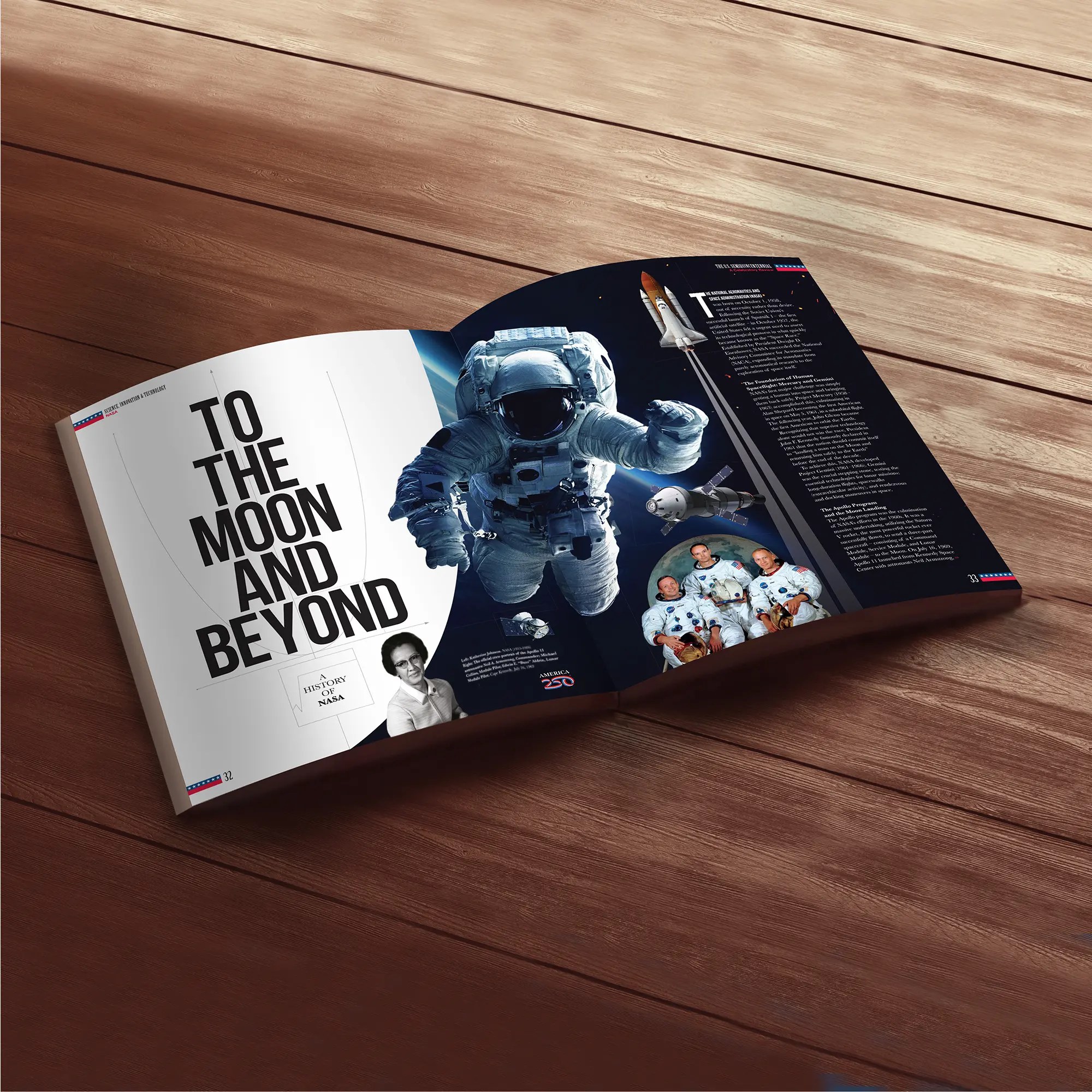
Curiosity is the founding American virtue that rarely gets its monument. Before the United States built skyscrapers or split the atom, it was a nation of tinkerers and observers — people who looked at the natural world and asked, stubbornly, how does this work, and could it work better? For 250 years that question has driven a remarkable procession of discovery, from a printer flying a kite in a storm to engineers landing a laboratory on another planet. This is the story of the American mind at work.
The Enlightenment Republic (1776–1830)
The Revolution that founded the country was itself a product of the Enlightenment, and several of its leading figures were practicing scientists. Chief among them was Benjamin Franklin, whose famous kite experiment helped prove that lightning was electrical and whose inventions — the lightning rod, bifocal spectacles, the efficient Franklin stove — he gave freely to the public, refusing to patent them.
Thomas Jefferson catalogued plants, fossils, and weather with the discipline of a naturalist and sent Lewis and Clark west as much for science as for territory. In 1793, Eli Whitney's cotton gin demonstrated how a single mechanical idea could remake an entire economy — for better and, in entrenching slavery, tragically for worse. The young republic prized useful knowledge, and made the inventor a national type.
"An investment in knowledge pays the best interest." — Benjamin Franklin
The Age of Invention (1830–1900)
The nineteenth century turned American ingenuity into an industrial force. Samuel Morse's telegraph annihilated distance, allowing a message to cross the country in moments rather than weeks. In 1876, Alexander Graham Bell patented the telephone and let human voices travel down a wire. And in his Menlo Park laboratory — the world's first true industrial research lab — Thomas Edison produced the phonograph, a practical electric light, and the systems to power it.
The era's defining battle, the "War of the Currents" between Edison's direct current and the alternating-current systems championed by George Westinghouse and the visionary Nikola Tesla, ended with AC electrifying the modern world. By century's end, the United States had become a society organized around invention itself — patents, laboratories, and the conviction that the future was something you could build.
The Rise of American Science (1900–1945)
In the new century, America moved from clever invention toward fundamental science. The Wright brothers achieved the first powered flight at Kitty Hawk in 1903. Robert Goddard launched the first liquid-fueled rocket in 1926, sketching the path to space. And the nation's universities and laboratories began drawing the world's finest minds — a migration that accelerated as scientists, Albert Einstein among them, fled fascism in Europe.
That gathering of talent culminated in the Manhattan Project, the vast wartime effort that produced the atomic bomb. It was a triumph of organized science and an enduring moral reckoning, demonstrating with terrible clarity that discovery and responsibility could never again be separated.
The Golden Age of Big Science (1945–1980)
The postwar decades were the height of American scientific ambition, fueled by federal investment on an unprecedented scale. In 1947, the transistor was invented at Bell Labs — the tiny switch that would make all modern computing possible. In 1953, the structure of DNA was decoded, with the American biologist James Watson sharing in a discovery that opened the molecular age of biology. In 1955, Jonas Salk announced a working polio vaccine and, like Franklin before him, declined to patent it.
And then came the journey that defined the era. Spurred by the Cold War shock of Sputnik, the United States created NASA and committed itself to the Moon. On July 20, 1969, Apollo 11 landed and Neil Armstrong stepped onto the lunar surface — the boldest expedition in human history, watched live by hundreds of millions. It remains the supreme proof of what American science and will could accomplish together.
"That's one small step for man, one giant leap for mankind." — Neil Armstrong, July 20, 1969
The Information Revolution (1980–2010)
The next transformation was quieter but no less profound. The transistor became the microchip, the microchip became the personal computer, and the laboratory network known as ARPANET became the Internet — an American invention that rewired civilization. Innovators like Steve Jobs and countless engineers in a stretch of California orchards soon to be called Silicon Valley put computing power into ordinary hands and, eventually, into every pocket.
Biology underwent its own revolution. The Human Genome Project, completed in 2003, mapped the entire sequence of human DNA — a feat that opened the door to personalized medicine and gene therapy. American science had moved from exploring the cosmos to reading the very code of life.
The Frontier Now (2010–Present)
American discovery has only accelerated. The detection of gravitational waves in 2015 confirmed a prediction Einstein made a century earlier and gave humanity a new way to listen to the universe. The CRISPR gene-editing revolution has made it possible to rewrite DNA with precision once thought impossible. Reusable rockets have collapsed the cost of reaching space and reopened the frontier. Rovers and helicopters explore Mars, and a new generation of telescopes peers back toward the dawn of the cosmos.
Most consequentially of all, artificial intelligence — built on decades of American research and computing power — has begun to reshape how knowledge itself is created. The nation that once flew a kite in a thunderstorm now builds machines that reason, and faces anew the old American question of how to wield a powerful tool wisely.
Why Science Matters at 250
The instruments changed beyond imagining — from a glass rod and a length of string to particle colliders and orbiting observatories — but the impulse never did. American science has always been democratic in spirit: practical, impatient, open to the outsider and the immigrant, convinced that knowledge is most valuable when it is shared and put to use. Franklin gave away his inventions; Salk gave away his vaccine; the Internet was given to the world.
That generosity of curiosity is among the country's greatest exports. At 250, the United States remains, more than anything, a place that keeps asking how the world works — and refuses to accept that the best discoveries are already behind it.
The full chapter on American science and innovation — from Franklin and Edison to NASA, the genome, and the age of intelligent machines — is captured in An Official Publication of America250.