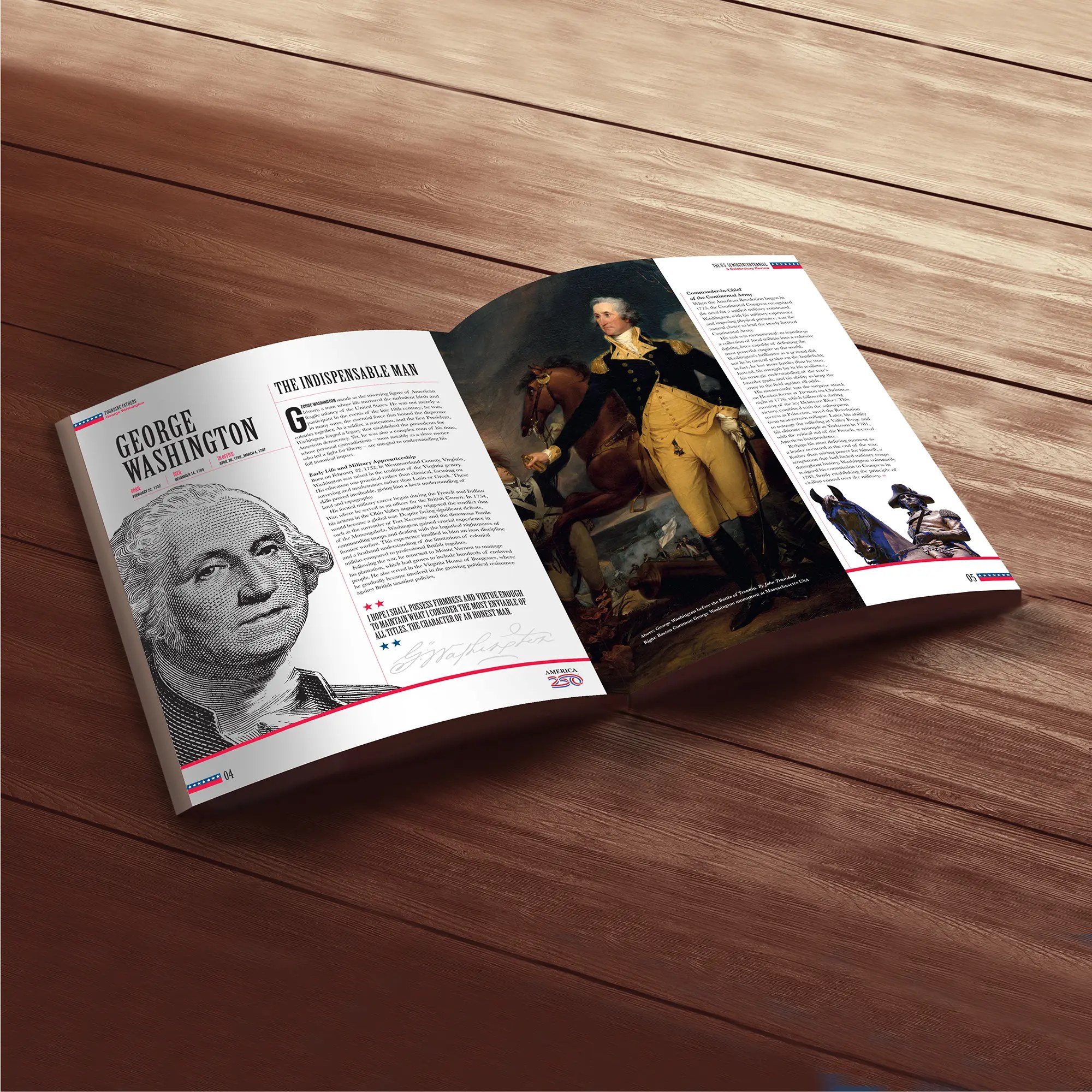
George Washington stands as the towering figure of American history — a man whose life mirrored the turbulent birth and fragile infancy of the United States. He was not merely a participant in the events that bound the disparate colonies together. He was, in many ways, the essential force that did so.
As a soldier, a statesman, and the first President, Washington forged a legacy that established the precedents for American democracy itself. And yet, like the country he helped build, he was a man of complexity — a slave owner whose personal contradictions are inseparable from his full historical impact.
Early Life and Apprenticeship in Power
Born on February 22, 1732, in Westmoreland County, Virginia, Washington was raised in the tradition of the Virginia gentry. His education was practical rather than classical — surveying, mathematics, and topography rather than Latin or Greek. These skills proved invaluable, giving him a keen understanding of land and frontier that would later shape both his military command and his vision for the young nation.
His formal military career began during the French and Indian War, where he served as an officer for the British Crown. In 1754, his actions in the Ohio Valley arguably triggered the conflict that would become a global war. Despite facing significant defeats — including the disastrous Battle of the Monongahela — Washington gained crucial experience in commanding troops and dealing with the logistical nightmares of frontier warfare. This experience instilled in him an iron discipline and a firsthand understanding of the limitations of colonial militias compared to professional British regulars.
"I hope I shall possess firmness and virtue enough to maintain what I consider the most enviable of all titles, the character of an honest man."
Commander-in-Chief of the Continental Army
When the American Revolution began in 1775, the Continental Congress recognized the need for a unified military command. Washington, with his military experience and imposing physical presence, was the natural choice to lead the newly formed Continental Army.
His task was monumental: to transform a collection of local militias into a cohesive fighting force capable of defeating the most powerful empire in the world. Washington's brilliance as a general did not lie in tactical genius on the battlefield — in fact, he lost more battles than he won. Instead, his strength lay in his resilience: his strategic understanding of the war's broader goals, and his ability to keep an army in the field against all odds.
His masterstroke was the surprise attack on Hessian forces at Trenton on Christmas night in 1776, which followed a daring crossing of the icy Delaware River. This victory, combined with the subsequent success at Princeton, saved the Revolution from near-certain collapse. Later, his ability to manage the suffering at Valley Forge and his ultimate triumph at Yorktown in 1781, with the critical aid of the French, secured American independence.
The Choice That Changed History
Perhaps his most defining moment came not on the battlefield, but at the end of the war. Rather than seizing power for himself — a temptation that had led failed military coups throughout history — Washington voluntarily resigned his commission to Congress in 1783, firmly establishing the principle of civilian command over the military.
It is hard to overstate how radical this choice was. King George III, upon hearing that Washington intended to relinquish power, reportedly said, "If he does that, he will be the greatest man in the world."
He did. And he was.
The First President
When the Constitution was ratified in 1788, there was never any real doubt who would be the first President of the United States. Washington was unanimously elected by the Electoral College in 1789 — a feat no other president has matched.
He approached the office with extraordinary care, aware that every decision he made would set a precedent. The Cabinet system, the two-term tradition, the title "Mr. President" rather than "Your Excellency," the very tone of the presidency — all bear Washington's careful, deliberate fingerprints. He understood that he was not merely governing, but designing.
A Complicated Legacy
No serious account of Washington can ignore the contradiction at the heart of his life: a champion of liberty who held more than 300 enslaved people at Mount Vernon. He wrestled with the institution privately for decades, eventually freeing his slaves in his will — the only Founding Father to do so. But the contradiction remained, and its weight is part of his story.
To honor Washington 250 years on is not to look past these contradictions. It is to look at him fully — as the indispensable man who, for all his complexity, helped build a nation founded on ideals that would eventually expand to include those his own time could not yet imagine.
Why He Still Matters at 250
Two and a half centuries after the Revolution, Washington's example endures because of what he chose not to do. He did not become king. He did not cling to power. He did not let personal ambition eclipse public duty. In an age when leaders so often choose the opposite, his restraint feels almost radical again.
This is why, in An Official Publication of America250, his story stands at the very beginning of our nation's 250-year journey. Because before there was a country, there was a choice — and a man willing to make it.
The indispensable man.